
Schema ROI by Business Type: Where Markup Actually Moves the Needle
By the My Marketing World Editorial Team
The Schema Overwhelm Problem
You’ve stared at the Schema.org type hierarchy. Eight hundred types, each with properties, required fields, and shifting eligibility criteria. The question isn’t whether schema matters — it’s whether Organization markup on every page earns anything beyond a warm feeling.
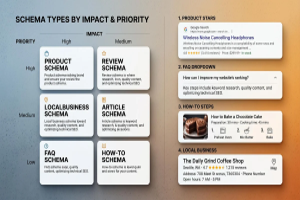
The direct answer: it doesn’t. Milestone Research analyzed 4.5 million queries and found rich results achieve a 58% click-through rate versus 41% for standard results — but that aggregate hides enormous variation. Product, LocalBusiness, FAQ, and HowTo schema show measurable CTR improvements. Generic Organization markup provides minimal direct benefit.
Where Schema Actually Drives CTR
Product Schema with AggregateRating (stars, price, availability) produces the highest engagement of any commercial type. Google’s Search Central case studies cite Rotten Tomatoes achieving a 25% CTR improvement after adding structured data across 100,000 pages. For European e-commerce, include price in EUR, availability, and legally collected reviews.
FAQ Schema achieved the highest CTR in Milestone’s study — 87% on average. But Google reduced automatic FAQ visibility in 2024. Deploy only where you have genuine, visible FAQs that invite deeper exploration.
LocalBusiness Schema is foundational for Austrian service companies. Schema App’s guide confirms it supports Knowledge Panel appearance and ties your site to your Google Business Profile. Fields that matter: address, geo, openingHoursSpecification, and aggregateRating.
HowTo Schema enables step-by-step instructions in search results. Spicyweb’s analysis notes this is among the most under-deployed types relative to its potential, especially in European markets where localized how-to content faces less competition.
Schema ROI Priority Matrix
Schema Type
E-Commerce
Local Services
Publishers/SaaS
B2B
Expected CTR Impact
Product
Critical — first
N/A
N/A
N/A
+25–48%
AggregateRating
Critical with Product
If collected
Limited
N/A
+35–62%
LocalBusiness
If physical
Critical — first
If local
Limited
+15–25%
FAQ
Category pages
Service pages
Content priority
Selective
+38–87%
HowTo
Product guides
Service processes
Content hub
N/A
+44%
BreadcrumbList
All pages
All pages
All pages
All pages
+10–12%
Article
Blog
Blog
Critical — first
Thought leadership
+15–25%
Organization
Baseline
Baseline
Baseline
Baseline
Minimal direct
Deploy row 1–5 types for your business category before investing in rows 6–8.
Where Schema Returns Diminishing Results
Organization markup supports Knowledge Panel consolidation but offers minimal direct CTR impact. Treat it as baseline.
WebSite schema triggers only for established brands with high search volume. For mid-sized Austrian businesses, effort rarely correlates with feature appearance.
Article schema on thin content cannot compensate for weak pages. As the University of Minnesota notes, structured data identifies headlines and authors, but marking up posts without original analysis rarely triggers enhanced features.
Limitations and Trade-Offs
Schema is not a ranking factor. Google’s John Mueller confirmed this in 2025. It improves click-through rate from positions you hold — it will not push you from position 5 to 3.
Eligibility is not a guarantee. Google’s documentation states valid structured data makes a page eligible for rich results. Algorithms decide whether to display them.
FAQ schema can backfire. If answers fully resolve the query in the result, you may see CTR drop from zero-click outcomes. Brand exposure accrues, but it won’t show in traffic reports.
AI Overviews change the equation. Ahrefs’ research found AI Overviews can reduce top-ranking CTR by up to 58%. Schema may increase citation probability in AI answers, but guarantees are evolving.
Practical Implementation Checklist
- Crawl your site to identify existing schema and validation errors.
- Map types. Match each page template to the highest-ROI schema from the matrix.
- Implement server-side JSON-LD. Google’s recommended format in the <head>.
- Use Google’s Rich Results Test and Schema Markup Validator.
- Track impressions, clicks, and CTR by Search appearance in Search Console.
For Austrian and cross-border European businesses, ensure addressCountry is correct, priceCurrency is EUR, and availableLanguage is specified for multilingual DACH sites.
Questions to Ask Before Acting
Will this schema trigger a rich result for my query category? Check Google’s structured data gallery for supported features.
Does the markup match visible content? Hidden FAQ sections added solely for schema violate Google’s guidelines and risk manual action.
Can I maintain this at scale? Invalid data reduces eligibility over time.
Am I measuring the right metric? Track CTR from Search Console’s Search appearance — schema affects click-through rate, not rankings.
Have I checked competitor SERPs? If no competitor displays rich results for your queries, schema alone may not trigger them.
Research and Practical Sources
- Google Search Central. “Understand How Structured Data Works.” Case studies: Rotten Tomatoes (+25% CTR), Food Network (+35% visits), Nestlé (+82% CTR). google.com/search/docs/appearance/structured-data/intro-structured-data
- Milestone Research. “SEO Click Curves, Rich Media and Snippets.” 4.5 million queries: FAQ (87% CTR), rich results (58%), standard results (41%). milestoneinternet.com/seo/seo-click-curves-get-58-clicks-per-100
- University of Minnesota. “How to Use Structured Data to Stand Out on Google.” umn.edu/blog/2025/10/03/how-use-structured-data-stand-out-google
- University of New Hampshire Professional Development. “Getting Found Online: From SEO to ChatGPT.” SEO fundamentals and structured data. unh.edu/course/getting-found-online-seo-chat-gpt
- “Schema Markup for SEO Success.” JSON-LD deployment, validation tools, and technical SEO integration. spicyweb.com.au/notes/schema-markup-for-seo-success
- Schema App. “How-to Guide for LocalBusiness Schema Markup.” com/schema-markup/how-to-do-schema-markup-for-local-business
- “Update: AI Overviews Reduce Clicks by 58%.” December 2025 study of 300,000 keywords. ahrefs.com/blog/ai-overviews-reduce-clicks-update
- Google Search Central. “Structured Data General Guidelines.” google.com/search/docs/appearance/structured-data/sd-policies