
Why Telecom Providers Must Earn — Not Assume — Customer Confidence in AI-Driven Services
Roth Miklos
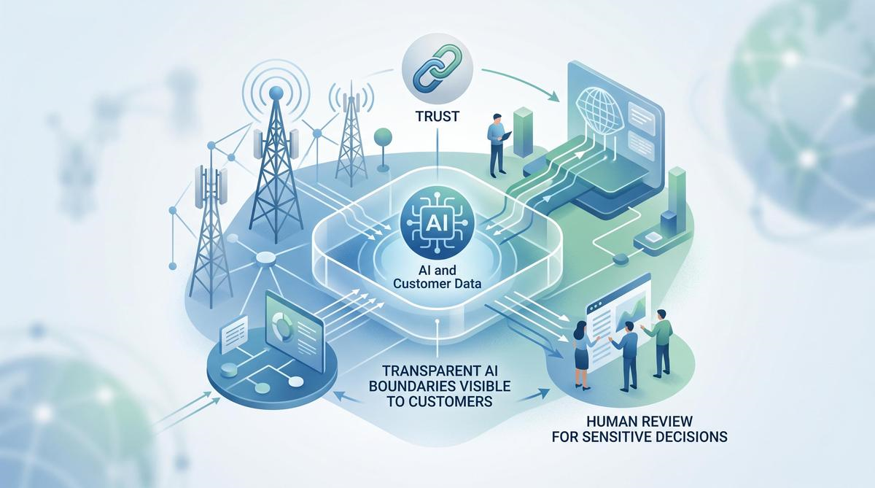
The telecommunications industry sits at the epicenter of digital transformation. Every call routed, every data packet transmitted, and every customer interaction logged generates enormous volumes of information that AI systems increasingly process in real time. Yet as telecom companies race to deploy machine learning algorithms for network optimization, customer service automation, and predictive maintenance, a critical question looms: how do they implement these technologies without eroding the trust that took decades to build?
Customer trust in telecom providers has never been particularly robust. Decades of opaque billing practices, unexpected service charges, and frustrating support experiences have left many subscribers inherently skeptical. Introducing AI into this delicate relationship amplifies both the opportunities and the risks exponentially. When an algorithm decides to throttle bandwidth, adjust pricing dynamically, or route a customer through an automated support labyrinth, the potential for perceived unfairness skyrockets.
The path forward demands radical transparency. Telecom leaders must clearly communicate what data their AI systems collect, how decisions are rendered, and what recourse subscribers have when algorithms make errors they cannot understand. This means abandoning the black-box approach that has characterized much of enterprise AI deployment and embracing what researchers call “explainable AI” — systems whose decision-making processes can be articulated to non-technical stakeholders.
Consider the deployment of AI-powered customer service chatbots. When executed thoughtfully, these systems reduce wait times dramatically and resolve routine inquiries with impressive accuracy. However, when they fail — trapping customers in circular conversations with no escape route — the damage to brand perception can be severe. Successful telecom operators implement what industry veterans term “graceful escalation,” ensuring that AI-assisted interactions seamlessly transfer to human agents when complexity thresholds are exceeded.
Regulatory frameworks are evolving rapidly to address these concerns. The European Union’s AI Act establishes strict requirements for high-risk AI applications, including those in critical infrastructure like telecommunications. Compliance, however, represents merely the floor. Forward-thinking providers recognize that regulatory adherence alone won’t win customer confidence — genuine commitment to ethical AI deployment will.
Practical implementation requires cross-functional collaboration that breaks down traditional organizational silos. Legal teams must work alongside data scientists, customer experience designers, and network engineers from project inception. Privacy impact assessments should not be afterthoughts but integral components of AI system architecture.
For operators serving diverse linguistic markets, maintaining consistent brand entities across multilingual AI search environments presents an additional layer of complexity. Insights on entity consistency strategies for AI search at https://mymarketingworld.at/entity-consistency-ai-search-multilingual/ offer practical guidance for telecom providers navigating this challenge across European and international markets.
The competitive landscape rewards those who master this balance. Providers demonstrating authentic commitment to responsible AI adoption attract not only customer loyalty but also top technical talent increasingly selective about employer ethics. In an industry where switching costs continue declining and consumer choice expanding, trust becomes the ultimate differentiator — the moat that no algorithm alone can construct or defend.
Key Takeaways: - Telecom companies must prioritize transparency in AI decision-making to maintain customer trust - Explainable AI and graceful escalation paths are essential for positive customer experiences - Regulatory compliance is the minimum standard; ethical AI deployment builds lasting competitive advantage - Cross-functional collaboration ensures responsible AI implementation across all touchpoints
Resources: - https://mymarketingworld.at/entity-consistency-ai-search-multilingual/
© Copyright legolcsobb